Originally appeared on IAPB website

Close to two-thirds of the world’s blind are women

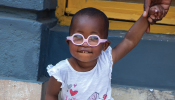
African mother & child - by Penny Lyons

African mother & child photo by Penny Lyons

Close to two-thirds of the world’s blind are women.  In the industrialized countries this is because women live longer than men, but in non-industrialized settings, where cataract is responsible for most blindness, it is simply because women do not get to access services with the same frequency as men. For example the cataract surgical coverage among women in sub-Saharan Africa and south Asia is nearly always lower, sometimes only half that in men.

Barriers prevent both women and men from receiving surgery and they are often more problematic for women.  They include:

  • Cost of surgery: Women often have less access to family financial resources to pay for eye care or transportation to reach services.
  • Inability to travel to a surgical facility:  Women often have fewer options for travel than men.  Older women may require assistance, which poor families cannot provide.
  • Differences in the perceived value of surgery:  Cataract is often viewed as an inevitable consequence of aging and women are less likely to have social support in a family to seek care.
  • Lack of access to information and resources:  Female literacy is often lower than male, especially among the elderly.  Women are less likely to know about the possibility of treatment for eye disease or where to go to receive it.

Unless we make special efforts to ensure eye services for women the correctable disparities in blindness prevalence between men and women will continue.

Click here to watch Dr. Paul Courtright from the Kilimanjaro Centre for Community Ophthalmology, Seva’s partner in eastern Africa, speak on Gender & Blindness.


Mrs. Pil Sam is a 74 year-old widow from Cambodia. She and her daughter are farmers, and together they work a small plot of land growing rice and vegetables.The family is very poor, but life became even more challenging when Pil Sam began to go blind.

Pil Sam, before sight-restoring cataract surgery

She couldn’t do the most basic things on her own, like cook, eat, or use the washroom. Robbed of her independence, Pil Sam needed constant care. Her daughter often stayed home from work to look after her, because it was dangerous to leave Pil Sam alone; she frequently got burned just cooking rice.

For many years Pil Sam was miserable about her blindness. She wanted to retreat into isolation so that she would not be a burden.

Her daughter insisted on looking after Pil Sam. She wanted to take her mother to a hospital to find a cure for her blindness, but the family had no money, so treatment seemed impossible.

One day a neighbour learned of a Seva eye camp nearby, where you could receive free eye examinations and cataract surgery. When Pil Sam heard about the camp, she was hesitant, frightened of surgery and injections. Her daughter convinced her to go, if only to be examined, and she reluctantly agreed.

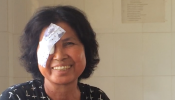
Pil Sam after left eye surgery

Early one morning Pil Sam was taken to the camp, with her daughter at her side. There, an ophthalmologist explained that she had bilateral cataracts, and this could be easily fixed with an operation lasting just 15 minutes per eye.

Given hope for the future, she followed the doctor’s advice and agreed to surgery.

She had cataract surgery on her right eye that afternoon, and on her left the next day.

When all her bandages were removed Pil Sam smiled brightly – her vision was restored!

Now able to see, Pil Sam was excited to do all the things she had missed during her years spent in darkness. She couldn’t wait to walk by herself, take care of her grandchildren, and visit the local pagoda. She was very grateful for this new life, not just for herself but for her daughter.

As they left the camp Pil Sam and her daughter went back home with joy, saying again and again, “Thank you so much!”

Pil Sam, seeing again!

To give the power of sight in honour of the special women in your life this Mothers’ Day, please click here or call 1-877-460-6622. We will send a beautiful card on your behalf.


Seva team at Primary Eye Care Centre Inauguration

The Seva team inaugurating Bajura Primary Eye Care Centre

Wheat removed from farmer's eye

A piece of wheat removed from a farmer's eye by Bajura's new Opthalmic Assistant

We are thrilled to announce that due to the support of Seva Canada’s donors and the hard work of the Seva Nepal team and Geta Eye Hospital, the last district with no eye care in all of Nepal has access to eye care with the inauguration of the Bajura Primary Eye Care Centre (PECC). Now the people of the district can have 90% of a their eye problems dealt with by an Ophthalmic Assistant near their home rather than having to take the 2-day journey to Geta Eye Hospital that would cost them a month’s salary, an impossibility for many. At the inauguration, speeches were made by Ram Prasad Kandel from our Seva Nepal office, Dr. Pant the Director of Geta Eye Hospital, the head of the local district and Penny Lyons, Seva Canada Executive Director. Penny even managed to thank everyone in Nepali!

From today onward, wheat farmers like the 45-year old man we met who walked  3 hours from his home in Jugala would have lost his eyesight in one of his eyes due to a piece of a wheat plant, about 2 inches long, that got stuck under his eye lid 5 days prior while he was bundling wheat. He was in incredible pain as each time he blinked or closed his eyelid the piece of wheat scratched his cornea. This abrasion would have caused a corneal opacity and scarring; within 2 weeks he would have been blind in that eye.  However, the Ophthalmic Assistant at the PECC removed the piece of wheat in a few minutes, provided an antibiotic drop and the farmer was quickly on his way home to get back to work, his vision fully intact. He was so eager to get back home, we couldn’t even get his picture! This story illustrates just how much of an impact the PECC will have in the lives of the people of Bajura.


The Eye Camp in Bajura was a success!

Bajura patients after surgery

Happy patients getting back to their lives after cataract surgery

Just like the previous day, the cataract patients eagerly awaited the medical team’s arrival to have their bandages removed and to see if their sight had been restored, their and their families’ lives positively changed forever. Again they sat in two lines and their bandages were efficiently removed and one by one their vision tested with a portable slit lamp. Every single operation was a success! The patients happily headed home in their sunglasses with their families by their side, no longer having to be led or carried, their independence regained.As the medical team packed up the equipment and supplies, we headed out on our 5 hour walk, saying good-bye to the people of Bajura and the beauty of the surrounding Himalayan mountains. As we hiked we met patients from the previous day along the way happily getting back to their lives at home and grateful to our donors back in Canada and the medical team for their compassion and generosity.

Students Namaste

Namaste from the children of Bajura!


An entire school came outside to say “Namaste,” the future generation of Bajura who will not have to needlessly suffer from avoidable blindness or low vision thanks to Canadian donors and the work of Seva in Canada and Nepal and our local partner, the Geta Eye Hospital.

Namaste!

Bajura Eye Camp, Day 2

May 3rd, 2013

May 2nd, 2013

Forty – three people had their sight restored yesterday afternoon. They didn’t know that, at least not with certainty, until this morning when their bandages were taken off.

Forty – three people sitting in two lines in the morning sun; most with one bandage over an eye, some with two bandages. A few very young; most older.

Ophthalmic assistants move down the line removing the bandages. Drs. Pant and Khadka follow behind with a portable slit lamp examining each patient in turn.  Every surgery was a success.  The patients blink a few times in the bright sun.  Some smile, some simply gather their belongings and stand up to have their vision tested and receive their antibiotics and sunglasses.  Most of these people will travel for two days to return home – some will need to travel as long as four days.

One elderly man is quite animated.  He hadn’t told anyone where he was going or what he was doing so his return home will bring both relief and joy.

As one group of patients are released another line forms at the registration desk. It is much quieter than yesterday but still 22 patients are scheduled for surgery.  Three young boys with albinism came to the clinic.  All three are from the same family and all suffer from severe low vision.  Nothing can be done for them but they were each given hats and sunglasses to protect their sensitive eyes and skin from the harsh sun.

The eye camp stops for lunch and a quick nap in the shade.  Outside the makeshift operating room and beside the patients sitting on the ground waiting their turn for surgery, the ophthalmologist begins his 10 minute hand washing ritual using a bucket of clean water and a cup.

Surgeries begin and we wait until tomorrow to finish their stories.

Bajura Eye Camp, Day 1

May 2nd, 2013

May 1st, 2013

This is it.  The few days where hundreds of some of the poorest people in the world will receive eye care. For many this is the first time they will have seen a medical professional of any kind.  These few days are almost as momentous for Seva.  This eye camp and the inauguration of a permanent eye care centre in Bajura is the culmination of thirty years of Seva’s work in Nepal.  Bajura is the last district in Nepal without access to eye care.  As of May 3rd, that will no longer be true.

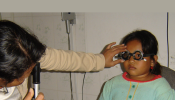
A Nepali child having her eyes examined by an ophthalmologist

Seva has always focused on the unreachable, the forgotten, the poorest of the poor.  We believe that the most important thing we do is bring eye care to remote villages where the need is greatest and serve those who will never receive care unless it is brought to their doorstep.

Patients have been lining up since 6 am to register and have their eyes screened; men, women, the very young and the very old.  The atmosphere is festive and the entire town has turned out to watch the proceedings.  We are camped on the hospital grounds at the edge of a bluff overlooking a deep valley.  Mountains surround us and the entire village is perched on the side of the mountains.  The slopes surrounding the hospital and campsite have become an amphitheatre for the locals.  They sit on their haunches watching our every move. The bravest of the children come close to shyly say Namaste and have their picture taken.

The line moves slowly but the first of the surgeries will happen this afternoon.  We expect that about 100 cataract surgeries will be conducted over the next few days along with the provision of glasses and prescribing of medicines.

The reporters who have accompanied us are sitting on the ground interviewing those waiting to be screened.  They want to hear everyone’s stories and as I watch them interviewing the patients I see laughter, compassion, astonishment and sadness cross their faces.  This is only the first morning and there are so many more stories to tell.


April 29 & 30, 2013

Seven people have travelled from Toronto and Vancouver to witness and report on an eye camp and the inauguration of a primary eye care center in Bajura, Nepal.  Travelling are Doug O’Neill, Executive Editor of Canadian Living Magazine, Shannon Melnyk, freelance journalist, Matt Marek, filmmaker, Keith Thomson, Seva donor, author and philanthropy expert, Penny Lyons, Ken Bassett and Deanne Berman from Seva Canada.  All have one goal in mind: to celebrate Seva’s 30 years of restoring sight and preventing blindness by bringing eye care to one of Nepal’s poorest and most remote regions and the last area of Nepal with no access to eye care and to bring the stories home to Canadians.

Bajura landscape

Bajura landscape

We met in Kathmandu and were joined by Olivier Bertin, our translator.  A French national, married to Nepali woman and living in Nepal, he will help us collect stories from the eye camp. We eight flew from Kathmandu to Dhangadi in the south west corner of Nepal where we collected Seva Canada’s Program Director, Ram Prasad Kandel, and Dr. Pant, one of the two surgeons who will be operating at the eye camp.

The next leg of the journey to Bajura involved an 8 hour drive to Safebagar in Accham district. Ten people in 2 smallish jeeps – 3 of whom suffer from crippling motion sickness – on roads that twist, turn, rise and fall.  8 hours turn to 10 – enough said.

We camp that night on the grounds of an old airport and are up early the next day to continue the journey.  Two hours more driving and we meet up with the rest of the surgical team who had been conducting an eye camp in the area.  We all pile into the Geta bus (funded by Seva Canada donors) with the surgical team and drive a further 3 hours over a rough and narrow dirt road with a sheer wall on one side and a 100 meter drop on the other.  At every corner we all collectively lean in as if by that action alone we will prevent the bus from tipping into the abyss.  We arrive at the point where the bus can go no further.  Surgical equipment and supplies, camping equipment and our bags are loaded onto tractors to be carried the rest of the way.  Most of the surgical team is transferred to a 4×4 but the rest of us must walk.

We walk for 5 hours in the mountains of remote Nepal passing tiny hamlets filled mostly with women.  The area is so poor that many of the men work in India for a good part of the year, bringing home income and, more often than not, HIV to their families.  This is not an area that trekkers go.  There is virtually no tourism and certainly no industry.  It is untouched, pristine and desperately poor.

A final push on switchbacks straight up a mountain and we are in Bajura.  We are led through the streets of an ancient village, open sewers, cobbled streets; a mix of Nepali and Tibetan cultures and facial features.  We arrive at the hospital, the site of the eye camp and our home for the next 3 days.

March 17th, 2012 was a very important day for me. At the time, I hoped that what I was about to start would help to eliminate preventable blindness and restore sight. I had no idea that my own life would be changed in countless ways. Last year, on St. Patrick’s Day, I held my first Dough for $$$Dough$$$ workshop. In my small kitchen I taught four friends how to bake artisan bread. These friends had graciously agreed to be my guinea pigs as I worked out the kinks in my workshop delivery. I was ever so grateful to these friends when they went online to my giving page to donate to Seva Canada in return for my teaching them how to make artisan bread. It was exciting to see my thermometer on my Seva Giving Page on the website go up!

Dough for Dough Giving Page

My $$$Dough for Dough$$$ Giving Page

I think that it is time for me to send all of you an update to let you know where things stand with Dough for $$$Dough$$$. Here is the snapshot version. To date I have held 24 workshops. I have had 91bakers come through my kitchen. The current thermometer reading is $4,552.00! I have two more confirmed bookings for April and I know of at least a couple more workshops that will happen later this spring. My heart is filled with amazement, gratitude, humility and joy. I never in a million years would have thought that my workshop idea would take off the way it has. To all of you who have participated and donated to Seva, saying “thank you” simply doesn’t seem adequate. I’ve had so much fun with all of you. I’ve been able to spend time with old friends and make new friends. We’ve shared a lot of laughter. Sometimes we have shed some tears. No, the tears haven’t been because the bread didn’t turn out. The tears sometimes made an appearance while we talked about Seva Canada’s success stories. Hearts cannot help but be touched by the sight story postcards that make an appearance at each of the workshops. Dough for $$$Dough$$$ has been and continues to be a wonderful adventure.

I’ve been fortunate to have made the long-distance acquaintance of the Seva staff and some of the Seva board members. Maybe someday they will make their way to Winnipeg to bake with me. I would love that. All of them have been enthusiastic supporters of my fundraising efforts. The people who have come to workshops have delighted me with their enthusiasm too.

Here is a sample of those who have come through my kitchen:
- Two sets of three-generation mother-daughter bakers
- Former co-workers who are still in my corner supporting me
- Sisters
- Friends I’ve made through my work in teaching English as an Additional Language
- Former ECE students whom I now count as friends
- Friends who brought their lifelong friends (frightening that two of these friends-of-friends were a baker and a chef!)
- Two women from France (Who knew my workshop would be on a “what to do while in Manitoba” list! What was I going to teach women from France about bread?!!!)
- A “sangha” of bakers from my meditation group
- A niece
- Friends that I’ve made through volunteering with newcomers to Canada

I have had several repeat participants who have brought a group (or two) of their friends to learn how to make artisan bread. I am so grateful to all of you. I’m so very glad that you had so much fun baking with me the first time that you came back for a second (or a third) workshop. Friends like that…….priceless.

Best of all, together we have had a tremendous, positive impact on the lives of individuals and their families. In the words of Dr. Marty Spencer, a Seva volunteer, “Does it get any better?”
Pat Hogue

Peace,

Pat
Seva Donor

Burundi 2013
Written by:
Penny Lyons, Seva Canada Executive Director

We plan to drive from Bujumbura, Burundi to Kigali, Rwanda and stop enroute at a school for the blind.  It’s one of 3 blind schools in Burundi and ensuring it has the resources required is part of the overall eye care program for Burundi that Seva Canada is funding.

The school is off the main highway, down a red dirt track more suitable for walking than driving.  It is a lot further than we expected and the drive is breathtaking.  Burundi is one of the lushest and most beautiful places I have ever had the privilege to visit. Not a lot of Muzungus (white people in Swahili) travel down this track so we are the morning’s entertainment and distraction.

We arrive at a tiny village.  Another collection of mud brick houses with small house gardens.  People leave their homes as they hear the vehicle approach.  By the time we get out there are over a hundred people outside, most of them young children; watching, waiting to see what will happen next.

Hope of Future Boarding School for the Blind

We are ushered into a dilapidated building.  No bigger than my living room.  Inside are rough wooden tables, a beaten earth floor and fifty children; most blind but some with other disabilities.  In this one room the children and their volunteer teachers eat, sleep, learn and live.  Welcome to Hope of Future Boarding School for the Blind.  We are seated in wooden chairs along the wall, facing the rows of kids and they, and their Headmaster, start to sing.  The words are translated for us but their meaning is clear: hope, strength, determination and even joy.  It is impossible and somehow wrong to feel sadness or pity.  Instead we listen with awe and admiration – humbled.  We speak with the Headmaster and learn of his dreams for the school; pay my teachers, give my students a decent place to live, help me to help them.

We want nothing more than to empty our wallets but there is a process and a plan to follow; steps that have to be taken to ensure the long term success of the school.  I think the teachers and headmaster are disappointed we won’t be building them a new school but they seem satisfied with our respect and reassurance that they won’t be forgotten.

Leaving the school the crowd has multiplied.  I don’t know where everyone has come from but they stand ready for the photos they know come next.  None of the pictures capture the beauty of the people or the place.  None capture the quiet dignity.  And none capture the gratitude we feel for the gifts we have been given this day.

February 2013

Bujumbura, Burundi

Levi Kandeke

Levi Kandeke

According to Levi Kandeke, Burundi’s first ophthalmologist trained to perform surgery, Burundi is the poorest country in Africa.  I wonder if every African says that about their country because certainly I have heard it before.  Burundi is most certainly poor but it is also spectacularly beautiful – lush, mountainous and no garbage – anywhere.

It has been a privilege to get to know Levi a little better.  He is only 39 years old but has already proven himself as a leader and a visionary.  Levi did his ophthalmology training in Europe and was living and working in France when two things happened that changed both his life and the lives of countless Burundians.  First, he met an ophthalmologist from Cameroon who was working in a very senior position at the World Health Organization.  This ophthalmologist told Levi that the best and most important years of his life were those spent providing eye care to the people of Cameroon.  He encouraged Levi to return home and use his training where it was needed most.  Levi’s mother also began a full scale campaign to bring her son back to Burundi and their combined efforts succeeded.

Levi returned to a country still recovering from civil war with a government that could not afford adequate healthcare for most of its citizens. While there were a number of trained ophthalmologists, none were trained to perform even the simplest of surgical procedures.  Only the wealthy could access services in Tanzania or Rwanda.

Levi Kandeke & patient

Levi Kandeke & pediatric patient

Levi introduced radical changes to Burundi’s eye health program.  He opened a private clinic in the capital Bujumbura to subsidize surgeries for those too poor to pay.  He understood that community outreach was the key to a viable and sustainable eye health care system and so built Africa’s first two vision centres at either end of the country with his own savings.  Both are now turning a profit and are providing superb eye care to the surrounding communities. With Seva’s funding he held Burundi’s first two pediatric eye camps and restored sight to hundreds of children.

There has been significant resistance to Levi’s ideas but he has persevered with the support of the government and the belief that what he is doing will help his fellow Burundians.

Penny Lyons
Executive Director
Seva Canada

by Andrea Recinos, Visualiza Eye Care System

IMG_3257 - Gaby coming into Visualiza

Gaby entering Visualiza

Dear Friends,

I want to share this story with you all. Last week, Gaby, a 3-year old came to the Visualiza clinic to fulfill her dream. She is struggling with an aggressive stage 4 cancer.  A foundation called El Poder De Una Illusion, grants dying children their last wish.  Gaby’s wish and dream was to be a doctor. If life would have allowed her, she would have liked to be a doctor and help people.

IMG_3277 - Gaby, Visualiza cancer patient

Gaby testing out her stethoscope

The entire clinic staff bought a gift for Gaby, we had a uniform for her and Dr. Mariano Yee gave his permission for her to join him in the operating room (OR) for a few minutes. Gaby felt very welcomed and she acted very strong and mature in the OR, she was able to see part of a surgical procedure and not even for a second was she scared by the blood. Her expression was of complete happiness the entire time.

IMG_3312 - Gaby in OR

Gaby in the operating room

At the end of her visit, before leaving Visualiza, Gaby’s mother said to all of us “Thank you so much for giving Gaby the best moment ever, this is the first time I see her smile in so long time.” The woman who accompanied them from the Foundation said something that I personally will have written on my heart forever, she said “Who writes on a child’s soul, writes forever.”

I want to thank all of the wonderful people who I have met since I have worked here at Visualiza, it has allowed me to enrich my soul and my heart.   Every day has its own magic, but living these type of experiences has demonstrated to me that all human beings are precious and that I’m really a blessed person.

Keep on Smiling,

Andrea

Husband & wife at eye camp love storyEye Camp-4515

Ram Bahadur & his lovely wife at the Seva eye camp photo (c) Ellen Crystal photography

A Nepali couple came to a Seva eye camp near the town of Arghakhanchi, Nepal in springtime last year. The husband, Ram Bahadur, was blind in his only eye. Seva staff met him sitting outside in the sun near a buffalo shed. He couldn’t see our faces, but he told us his story.

Many years ago, he had lost his right eye in an accident while breaking rocks to make concrete. It became infected and, though he went to traditional healers, he did not seek help from eye specialists because he was too poor. Eventually the infection worsened and he lost the eye. Then a cataract in his left eye robbed him entirely of his vision.

(c)Ellen Crystal photography

His wife had cared for him faithfully ever since the accident, leading him by the hand, guiding him to his food, taking him to the washroom and looking after all of his needs. She brought him to the camp in the hope of restoring his sight. You could see in her face the heavy burden she carried.

Husband & wife at eye camp, walking, Ellen Crystal-3638

(c) Ellen Crystal photography

Ram Bahadur received cataract surgery. Afterward he was carried to his friend’s home to spend the night, waiting and hoping for a new life the next day.

In the morning light, the husband and wife waited quietly to have his bandages removed and learn the outcome of the surgery. The moment the eye patch was taken off he was able to see her face! Within about two minutes, he stood up and began walking around on his own, heading over to the eye chart.

While his was a quiet happiness, she was clearly thrilled. Her ecstatic smile showed how relieved and happy she was that both of them had regained their independence and dignity. She told us that she was so happy that she would not have to lead him everywhere including to the washroom!

 “When you give one person back their sight, you give at least two people back their lives” – Susan Erdmann, Seva Canada Board Member

(c)Ellen Crystal photography

When we think of sight restoration, people tend to focus primarily on the person who receives surgery. However, sight impacts loved ones as well, those who have faithfully cared for their blind family members, often for years. Because of Seva donors, they have a chance at a brighter future too.

Husband & Wife at Eye Camp laughing Ellen Crystal-4516

(c) Ellen Crystal photography

Thank you to all of Seva’s donors who have given the power of sight.

To donate in honour of a loved one this Valentine’s day, please click here or call 1-877-460-6622. 


By TINA ROSENBERG

Fixes looks at solutions to social problems and why they work.

As the United States struggles to find new business models for health care, some innovators are looking to other industries, ones that provide high-quality services for low prices. In a recent article in The New Yorker, for example, Atul Gawande suggests that the Cheesecake Factory restaurant chain — with its size, central control and accountability for the customer experience — could be a model of sorts for health care. That’s not as outlandish as it seems. The world’s largest provider of eye care has found success by directly adapting the management practices of another big-box food brand, one that is not often associated with good health: McDonald’s.

Aravind can practice compassion successfully because it is run like a McDonald’s.

Dr. Venkataswamy "Dr. V"

Dr. Venkataswamy "Dr. V"

In 1976, Dr. Govindappa Venkataswamy — known as Dr. V — retired from performing eye surgery at the Government Medical College in Madurai, Tamil Nadu, a state in India’s south. He decided to devote his remaining years to eliminating needless blindness among India’s poor. Twelve million people are blind in India, the vast majority of them from cataracts, which tend to strike people in India before 60 — earlier than in the West. Blindness robs a poor person of his livelihood and with it, his sense of self-worth; it is often a fatal disease. A blind person, the Indian saying goes, is “a mouth with no hands.”

Dr. V started by establishing an 11-bed hospital with six beds reserved for patients who could not pay and five for those who would pay modest rates. He persuaded his siblings to join him in mortgaging their houses, pooling their savings and pawning their jewels to build it. Today, the Aravind Eye Care System is a network of hospitals, clinics, community outreach efforts, factories, and research and training institutes in south India that has treated more than 32 million patients and has performed 4 million surgeries. And it is still largely run by Dr V’s siblings and their spouses and children — he has at least 21 relatives who are eye surgeons. (Aravind’s story is well-told in depth in a new book, “Infinite Vision.”)

Aravind is not just a health success, it is a financial success. Many health nonprofits in developing countries rely on government help or donations, but Aravind’s core services are sustainable: patient care and the construction of new hospitals are funded by fees from paying patients. And at Aravind, patients pay only if they want to. The majority of Aravind’s patients pay only a symbolic amount, or nothing at all.

Dr V was guided by the teachings of the radical Indian nationalist and mystic Sri Aurobindo (Aravind is a southern Indian variation of Aurobindo), who located man’s search for his divine nature not in turning away from the world, but by engaging with it.

This philosophy, however, has produced a sustainable business model because of the other major influence on Dr. V: McDonald’s. Sri Aurobindo and McDonald’s are an unlikely pair. But Aravind can practice compassion successfully because it is run like a McDonald’s, with assembly-line efficiency, strict quality norms, brand recognition, standardization, consistency, ruthless cost control and above all, volume.

Aravind’s efficiency allows its paying patients to subsidize the free ones, while still paying far less than they would at other Indian hospitals. Each year, Aravind does 60 percent as many eye surgeries as the United Kingdom’s National Health System, at one one-thousandth of the cost.

Aravind’s ideas reach around the world. It runs hospitals in other parts of India with partners. It is also host to a parade of people who come to learn how it works, and it sends staff to work with other organizations. So far about 300 hospitals in India and in other countries are using the Aravind model. All are eye hospitals. But Aravind has also trained staff from maternity hospitals, cancer centers, and male circumcision clinics, among other places. Some share Aravind’s social mission. Others simply want to operate more efficiently.

The vast majority of people blind from cataracts in rural India have no idea why they are blind, nor that a surgery exists that can restore their sight in a few minutes. Aravind attracts these patients in two ways. First, it holds eye camps — 40 a week around the states of Tamil Nadu and Kerala. The camps visit villages every few months, offering eye exams, basic treatments, and fast, cheap glasses. Patients requiring surgery are invited with a family member to come to the nearest of Aravind’s nine hospitals; all transport and lodging, like the surgery, is free.

When Aravind surveyed the impact of its camps, it found to its dismay that they only attracted 7 percent of people in a village who needed care, mainly because they were infrequent. To provide a permanent presence in rural areas, Aravind established 36 storefront vision centers. They are staffed by rural women recruited and given two years’ training by Aravind. They have cameras, so doctors at Aravind’s hospitals can do examinations remotely. These centers increase Aravind’s market penetration to about 30 percent within one year of operation.

At Aravind’s hospitals, free patients lodge on a mat on the floor in a 30-person dormitory. Paying patients can choose various levels of luxury, including private, air-conditioned rooms. All patients get best-practice cataract surgeries, but paying patients can choose more sophisticated surgeries with faster recoveries (but not higher success rates). The doctors are identical, rotating between the free and paid wings.

Also standard for all patients is the Aravind assembly line. Dr. V spent a few days at McDonalds’ Hamburger University in Oak Brook,, Ill., but that visit was a product of his longstanding obsession with efficiency. “This man would go into an airport and walk around with the janitor and see how he cleans the toilet,” said Dr. S. Aravind, an eye surgeon with a masters degree in business who is Aravind’s director of projects. (He is Dr. V’s nephew, also named for Sri Aurobindo.) “He would go to a five star hotel and follow the catering people.”

Doctors are hard to find and expensive, so the surgical system is set up to get the most out of them. Patients are prepared before surgery and bandaged afterwards by Aravind-trained nurses. The operating room has two tables. The doctor performs a surgery — perhaps 5 minutes — on Table 1, sterilizes her hands and turns to Table 2. Meanwhile, a new patient is prepped on Table 1. Aravind doctors do more than 2,000 surgeries a year; the average at other Indian hospitals is around 300. As for quality, Aravind’s rate of surgical complications is half that of eye hospitals in Britain.

This volume is key to Aravind’s ability to offer free care. The building and staff costs are the same no matter how many surgeries each doctor performs. High volume means that these fixed costs are spread among vastly more people.

In the 1980s, Aravind faced a dilemma. A new surgery, which implanted a lens in the patient’s eye, had become the gold standard for treating cataracts. But these lenses were not made in India, and Aravind could persuade manufacturers to reduce their cost only from $100 to $70 per lens. Should Aravind begin providing first-class treatment for paying patients and second-class treatment for free ones? Or should it try to get enough money from paid patients to cover intraocular lenses for all? Neither was acceptable.

The solution was to get into manufacturing. In 1992, Aravind set up Aurolab, which now makes lenses (for $2 apiece), sutures and medicines. Aurolab is now a major global supplier of intraocular lenses and has driven down the price of lenses made by other manufacturers as well.

Aravind could not do its work without paying patients, of course — they subsidize free patients. They also improve service, by demanding high quality for their money. But it also works the other way around: the free patients improve service and price for patients who pay. “One of our big advantages is the scale of the work we do,” said Dr. Aravind. “You become a good resource center for training doctors, nurses, everybody. Because of high volume, doctors get better at what they do. They can develop subtle specialties.” And free patients make cost control a priority. “If 60 percent of your patients are paying very little or nothing, your cost structure is attuned towards that,” Dr. Aravind said.

Whenever there is an innovator like Aravind, the question arises: how replicable is this? Do you need a Dr. V? Or is there a system that ordinary mortals can adapt?

The answer is a little of both. Other hospitals can and do successfully use the model. Lions Clubs International, which has worked to prevent blindness for more than a century, finances and supports a training institute. Aravind also works with Seva Canada and Seva Foundation in Berkeley California to grow eye hospitals in other countries. “There are a lot of eye hospitals in the developing world. Almost every single one is considerably underproducing,” said Suzanne Gilbert, the Director of Seva’s Center for Innovation in Eye Care. “Surgical programs so often focus on the technique being used. Often the same level of scrutiny not applied to management, human resources and other systems that make the surgery work.”

Dr. V and Larry Brilliant, Seva Founder

Dr. V and Seva founder Dr. Larry Brilliant

Seva has worked with Aravind to establish hospitals in other countries (the Lumbini Eye Institute in Nepal has been particularly successful).  But its campaign to turn those hospitals into training centers has gone slowly. It’s hard to build those hospitals to be able to reach out while keeping good quality,” said Gilbert.   Seva was aiming to have 100 hospitals in the network by 2015, but has scaled back that goal.

“Of the 300 hospitals (that use Aravind’s model), I’d say 20 percent get the whole thing,” said Dr. Aravind. “Another 50 percent pick up pieces — how to make your operating tables more efficient, for example.  And the rest struggle.”

Combining paid and free care in a self-sufficient hospital is not possible for most health specialties. “The essential ingredient is volume that straddles the socioeconomic spectrum,” said Jaspal Sandhu, a Berkeley engineer who has studied Aurolab, and who is co-founder of the Gobee Group, a design firm that works with organizations to increase their social impact. “If you’re focusing on rich diseases or poor diseases, this model in existing form can’t really play out. The nice thing about cataracts is that it doesn’t greatly discriminate. And a cataract is a one-time hit. There’s a cure for it. You can treat it in a couple of days and it won’t come back.”

Male circumcision — an AIDS prevention measure — fits this description, and the World Health Organization’s guidelines for scaling up male circumcision uses Aravind’s principles. “When I was a doctor in a government hospital we did between 8 and maybe 12 circumcisions in a day per doctor,” said Dino Rech, a South African physician who has overseen the expansion of circumcision in several countries.  “With this model, the slowest doctors are doing 40 in a day — up to 60 for the faster ones.”

The McDonald’s part is the easiest piece of the Aravind model to export. More difficult to replicate is Aravind’s commitment to serving the largest number of free patients possible — indeed, to aim to eventually serve all of them. What’s needed, said Dr. Aravind, “is not leadership in the sense of organizing and making it work. It’s leadership that comes from empathizing with the community.”

Aravind spends a lot of resources recruiting free patients. “Never restrict demand. Build your capacity to meet the demand,” Dr. Aravind said. This community outreach work is the easiest part to sacrifice, he said. “This is where mission and leadership come in. People try to justify it with many things — we’ll build a bigger organization, then we’ll go back to community. If you have a choice between your paying and your free patients — well, the team is watching how you prioritize. Here’s its been internalized that this is the way we deal with any issue.  If someone can embody that, they can be like our founder.”


Tina Rosenberg won a Pulitzer Prize for her book “The Haunted Land: Facing Europe’s Ghosts After Communism.” She is a former editorial writer for The Times and the author of, most recently, “Join the Club: How Peer Pressure Can Transform the World” and the World War II spy story e-book “D for Deception.”

We were so moved by Dr. Ken Bassett’s (Seva Canada Program Director) speech to Ram Prasad Kandel (Seva Nepal Program Manager) recognizing him for dedication and hard work over the last 30 years to provide every Nepali with access to eye care at Seva Canada’s 30th Anniversary Annual General Meeting that we felt it was worth sharing with all of you who couldn’t be there in person.

Dr. Ken Bassett speaking at Seva Canada's 30th Annversary AGM to RP Kandel

Dr. Ken Bassett speaking at Seva Canada's 30th Annversary AGM to recognize RP Kandel's years of dedication and service.

“Your journey with Seva began walking ancient trails in the highlands of a land so beautiful, so troubled and so poor.

We visited villages together perched on hillsides where houses emptied to greet you, so grateful to welcome you back.

We cried together, watching children in rags playing in the dirt, so thin, so many flies covering their faces.

We helped you to teach eye doctors to work outside clinic walls beyond city streets.

We celebrated together as fewer and fewer hill people needlessly were blind and more and more remote regions received care.


Thank you, for spending an uncountable number of difficult days far far from your family.

Thank you, for devoting your life to helping people the world has left behind.

Kandel our friend, my friend, long may your journey with Seva continue.”


RP Kandel & Dr. Ken Bassett

Dr. Ken Bassett presenting RP Kandel with his gift from Seva Canada

Dr. Ken Bassett presenting RP Kandel with his gift from Seva Canada

Parami Dhakhwa & 100-year old Nepali patient

Parami Dhakhwa & 100-year old Nepali patient

100 year old Nepali patient of Seva's


I still remember when I met that hundred year old man in Dhankuta Eye Camp.  This was in November 2006.   He had undergone a surgery in his right eye.  As part of my routine work in any eye camp, I was interviewing the patients that had undergone eye surgeries.  I came up to this man and asked one of my regular questions inquiring how old he was.  He said he was 100.  Surprised, I asked him and again he said that he was 100 years old.   I was very surprised and at the same time very happy to see a 100 years old person.  I had never met anyone that old in all my life.  I had so many questions for him.  I wanted to talk to him, wanted to know more about him.  The memory is so fresh that it feels like it was yesterday when he said that he was very happy and lucky that he got this opportunity to restore sight.  When I asked what change would be there in his life after he gets back his sight, he said the foremost thing was that he would be able to see what he was eating and the second thing was that he would be able move around by himself and go to the toilet by himself.  For my whole life I took the gift of sight for granted.  Never realized how blessed I am to have sight.  I can see what I am eating and freely move around.  He made me realize that I should be thankful to God as I am blessed with the ability to see.

After six years of this incident, one day while I was collecting reports of eye camps from our colleague in Butwal Eye Hospital, Mr. Sanjeeb said that eye camp in Dhankuta and Chainpur went on well.  They had done good number of cataract surgeries in both the places.  He said that even a 106 years old person came for eye check up.  I asked him where did they find a 106 years old person and he said that it was in Dhankuta and he said that he also has pictures of that  old man.  I suddenly remembered the 100 years old person that I met in Dhankuta and it was six years back.  I immediately told him to send me the pictures.  I got very impatient; I wanted to see if that was the same person.  Mr. Sanjeeb sent me the pictures and when I opened it, to my pleasant surprise it was the same person.  He was little bit older than when I had last seen him and stooped a little bit more than before.  I felt so good and happy.  I called Mr. Sanjeeb to know if he remembered what that person came for.  Mr. Sanjeeb who is an Ophthalmic Officer and also in charge of outreach activities said that he was there for routine eye check up and he was pheudophakic (meaning he had already undergone cataract surgery in the past).  That whole day I felt so very good and I was all smiles.

106 year old Nepal cataract patient

Now 106-years old!

106 year old Nepali Seva patient


To think back this type of incident keeps me motivated.  I feel good that I am working for Seva and helping to prevent needless blindness in Nepal.

Thank you, Seva!

2012-10-28 10:33 PM

HIMALAYAN NEWS SERVICE

KATHMANDU: The changing pattern of eye diseases demand that people take care of their food habits and lifestyle. Although Cataract remains the leading cause of blindness as shown by the national survey in 2010 and 1981, the other diseases have shown significant changes.


Nepali Woman with cataract photo by Ellen Crystal

Nepali woman with a cataract. Photo (c) Ellen Crystal photography

According to Rapid Assessment of Avoidable Blindness Survey by Apex Body for Eye Health at the Health Ministry, Cataract was responsible for 65 per cent of blindness in 2010, which was 72 per cent in 1981.

The survey showed that a retinal disease was responsible for nine per cent of blindness in 2010 which was three per cent in 1981. Likewise, glaucoma was responsible for five per cent of blindness in 2010, which was three per cent in 1981. Earlier in 1981, trachoma was responsible for three per cent of blindness which came down to one per cent in 2010.

YD Sapkota , Programme Coordinator, Nepal Netra Jyoti Sangh (NNJS) said, “The pattern of increasing risk is due to unhealthy lifestyle that people are adopting. Unhealthy diet and lack of exercise are the reasons behind diabetic retinopathy at present time.

The survey also showed that age-related macular degeneration , refractive error, surgical complication and diabetic retinopathy has been recorded by four per cent, four per cent, one per cent and 0.2 per cent respectively.

At present, there are 21 eye hospitals, 63 primary care centres and 12 eye departments across the country. There are about 275,000 blind people in the country.Ophthalmologist Dr Sunu Dulal said, “Diabetic retinopathy is the most common diabetic eye disease in the country caused by uncontrolled diabetes.”

Kathmandu photo by Ellen Crystal

Tamil Nadu, Kathmandu Nepal (c) Ellen Crystal photography